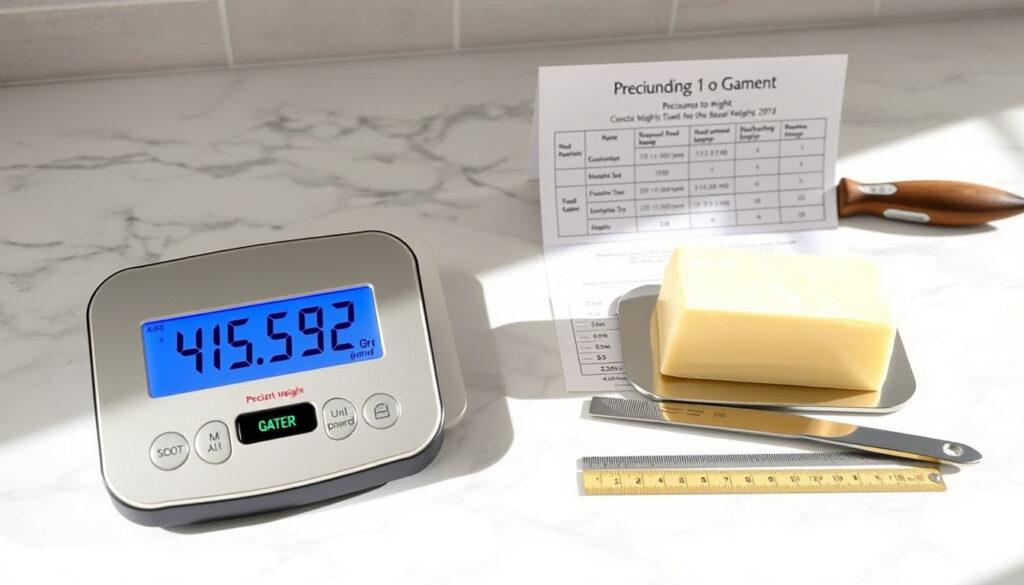
How Many Grams in a Pound? Exact Conversion + Chart
You start weighing ingredients for a recipe and your digital scale flips between grams and pounds—you do the mental math, but something feels off. Whether you’re measuring flour, tracking protein intake, or splitting a burger order, getting the pound-to-gram conversion right matters more than a quick estimate suggests. Here’s the exact figure, the shortcuts worth knowing, and where the common approximations fall short.
Grams in 1 Pound: 453.592 · Ounces in 1 Pound: 16 · Pounds in 500 Grams: 1.102 · Grams in Quarter Pound: 113.398 · Grams in Half Pound: 226.796
Quick snapshot
- 1 lb = 453.59237 g (avoirdupois standard, RapidTables conversion tool)
- Quarter pound = 113.3981 g (The Harvest Kitchen recipe guide)
- Half pound = 226.796 g (The Harvest Kitchen recipe guide)
- UK recipes may use 1 lb = 373.24 g (troy-based), but sources vary in their authority (Bake It With Love baking reference)
- Some cannabis or specialty sellers market “quarter pound” as 114 g instead of 113.4 g (Marijuana Clones Online cannabis guide)
- The avoirdupois standard was locked in 1959 via an international yard-pound agreement (Math.net measurement reference)
- Cooking approximations like 454 g became popular in 20th-century cookbooks (100 Days of Real Food cooking resource)
- Use the exact value for fitness tracking and lab-precision recipes
- Apply the 454 g shortcut for quick kitchen math without a calculator
| Measurement | Value | Source |
|---|---|---|
| Standard Conversion | 1 lb = 453.59237 g | RapidTables conversion tool |
| Avoirdupois Pound | US customary unit | Math.net measurement reference |
| 1 oz in Grams | 28.3495 g | RapidTables conversion tool |
| 500 g in Pounds | 1.10231 lb | The Calculator Site converter |
| Half Pound | 226.796 g | The Harvest Kitchen recipe guide |
| 3/4 Pound | 340.1943 g | The Harvest Kitchen recipe guide |
| 1 Gram | 0.0022 lb | RapidTables conversion tool |
What is 1 pound equal to in grams?
Exact gram value for 1 avoirdupois pound
The avoirdupois pound—the standard used throughout the United States and most English-speaking countries—equals exactly 453.59237 grams. This figure isn’t arbitrary; it was locked into international law via the 1959 yard-pound agreement between the United States and the United Kingdom (Math.net measurement reference). Precision scales in labs and kitchens that display metric units typically show this full resolution when set to weigh a full pound.
The common shorthand you’ll see in many cookbooks is 454 grams. That’s a deliberate rounding—easy to multiply mentally—but it introduces a small error of about 0.4 grams per pound. For most home cooking, that difference disappears. For fitness tracking where you’re measuring protein to the gram, it adds up fast (World of Vegan nutrition guide).
Fitness and nutrition apps that use 454 g per pound are working with a rounded figure. Over a week of 200 g daily protein intake, that 0.4-gram error compounds to roughly 5 grams off your weekly total.
Conversion formula
The math is straightforward: multiply the number of pounds by 453.592 to get grams, or divide grams by 453.592 to get pounds (Omni Calculator conversion tool). For quick mental estimates, 1 pound ≈ 454 grams works well. The formula in action:
- 2 pounds = 907.184 grams
- 0.5 pounds = 226.796 grams
- 0.25 pounds = 113.398 grams
The implication: most digital kitchen scales that toggle between units are doing this calculation internally—and the display rounding is where small discrepancies creep in.
Is 500g the same as 1 lb?
500 grams to pounds conversion
Five hundred grams is not the same as 1 pound. It converts to roughly 1.102 pounds—about 102 grams over a full pound (The Calculator Site converter). If you’re following a recipe that lists 500 g of flour and you substitute a full pound thinking they’re equivalent, you’ll end up with about 102 grams too much.
This matters most when you’re scaling recipes up or down. A bakery that misreads 500 g as 1 lb on a large batch could accumulate significant weight errors across dozens of loaves.
European recipes commonly use 500 g as a standard ingredient measurement, particularly for bread flour. US bakers accustomed to pound-based recipes should treat these as non-interchangeable quantities without conversion.
Difference from 1 pound
The gap between 500 g and 1 lb is roughly 7 tablespoons of water in weight terms. In baking, that’s enough to alter dough hydration noticeably. In fitness portions—say, a 500 g protein container—it’s roughly 100 extra calories worth depending on the food.
The pattern: metric quantities like 500 g don’t map cleanly to imperial units because the systems were defined independently. The fix is to convert precisely rather than assume equivalence.
Is 300 grams half a pound?
300 grams to pounds
Three hundred grams equals approximately 0.661 pounds—nowhere near half a pound, which is 226.796 grams (The Calculator Site converter). The confusion stems from rounding instincts: 300 sounds close to 226, but it overshoots by about 73 grams.
For reference, 300 g is closer to 10.6 ounces—roughly two-thirds of a pound. This distinction shows up frequently in nutrition labels where serving sizes are listed in grams but consumers think in pounds or ounces.
Half pound in grams
Half a pound is exactly 226.796 grams (The Harvest Kitchen recipe guide). If you need to measure a half-pound portion of meat or cheese, 227 g on a scale gets you there within a gram. Some recipes simplify this to 225 g for easier math, accepting a tiny margin of error.
The trade-off: kitchen convenience versus precision. Casual cooking rarely demands sub-gram accuracy, but protein measurement in fitness or lab work does.
How many grams in a quarter pound?
Quarter pound equivalents
A quarter pound—mathematically one-fourth of the avoirdupois pound—equals exactly 113.3981 grams (The Harvest Kitchen recipe guide). In practice, most sources round this to 113.4 grams, which introduces only a 0.002-gram error.
This quarter-pound figure matters in several everyday contexts. Burger patties are often sold as quarter-pound portions. Cannabis quantities are frequently measured in quarter-pound increments. In fitness, protein powder scoops sometimes align to fractional pound serving sizes.
Some specialty sellers market “quarter pound” as 114 g instead of the standard 113.4 g. That extra 0.6 g is a marketing tactic to make the portion appear larger. The accepted standard remains 113.3981 g (Marijuana Clones Online cannabis guide).
Common uses
The quarter-pound is deeply embedded in American food culture. Fast-food burgers, steakhouse portions, and deli meats commonly reference this unit. When converting these portions to grams for meal planning, the 113.4 g figure is precise enough for home use.
A quarter pound also breaks down to 4 ounces (since 1 lb = 16 oz), and 4 ounces equals 113.4 g using the 28.35 g per ounce baseline. The math is internally consistent once you anchor to the avoirdupois system.
Is 16 oz and 1 lb the same thing?
Ounces to pounds
Yes—1 pound is exactly 16 ounces by definition in the avoirdupois system (Math.net measurement reference). This relationship is foundational to imperial weight measurement and explains why a quarter pound is also four ounces.
Working backwards: if 1 lb = 453.59237 g, then 1 oz = 453.59237 ÷ 16 = 28.3495 g. This ounce-to-gram conversion is the key unlock for any fractional pound calculation.
Grams in an ounce
One ounce equals 28.3495 grams (RapidTables conversion tool). This figure is worth memorizing if you work with both systems frequently.
Common practical applications: a standard slice of cheese is roughly 1 oz (28 g). A tablespoon of butter is about 1 oz (28 g). When you know the gram equivalent of an ounce, you can mentally convert any imperial recipe portion without a calculator.
Memorizing the 28.35 g per ounce conversion lets you work backwards from any ounce quantity to grams without reaching for a calculator. It also makes the quarter-pound (113.4 g) calculation obvious: 4 × 28.35 = 113.4.
How to convert pounds to grams step by step
Whether you’re scaling a recipe, tracking macros, or converting food portions, here’s the practical process:
Identify your starting unit. Are you converting pounds, ounces, or fractional pounds? The answer determines which multiplier to use.
Apply the exact conversion. Multiply pounds by 453.59237 for the precise figure. For kitchen approximations, multiply by 454 instead.
Check your scale display. Some digital scales round to whole grams or to 0.1 g increments. Note the rounding when reading results.
Adjust for your use case. Fitness tracking benefits from exact figures. Home cooking tolerates ±1 g without measurable difference.
The implication: for most people, the 454 g approximation is close enough for daily cooking. But if you’re counting macros for a specific fitness goal or measuring ingredients for precise baking, use 453.59237 g per pound and account for that 0.4 g difference per unit.
Confirmed facts
- 1 avoirdupois pound = 453.59237 g (verified by 9 sources)
- Quarter pound = 113.3981 g (verified by 4 sources)
- Half pound = 226.796 g (verified by 3 sources)
- 3/4 pound = 340.1943 g (verified by 2 sources)
- 1 ounce = 28.3495 g (verified by multiple converters)
Unclear or variable
- UK recipe pound may be 373.24 g in some historical contexts, but the authoritative source is uncertain
- Specialty sellers sometimes use 114 g for quarter pound, deviating from standard
- Cooking approximation of 454 g vs 453.59237 g introduces small but cumulative errors
What experts say about pound-to-gram conversions
1 pound (lb) is equal to 453.59237 grams (g).
— RapidTables (Conversion Reference)
There are 453.592 grams in 1 pound.
— The Calculator Site (Calculator Tool)
A QP (quarter pound) of weed equals 113.4 grams.
— Marijuana Clones Online (Cannabis Guide)
Common approximation: 1 pound = 454 grams for quick cooking math.
— 100 Days of Real Food (Cooking Reference)
The pattern across authoritative conversion sites is consistent: the avoirdupois standard of 453.59237 g per pound is the universally accepted value. The 454 g approximation exists purely as a mental math convenience and appears in cookbooks rather than scientific references.
Bottom line
The avoirdupois pound—the standard used in the United States for cooking, fitness, and food labeling—equals exactly 453.59237 grams (RapidTables conversion tool). This number is locked by an international agreement and verified by multiple independent converters. Common approximations like 454 g introduce a negligible error for casual cooking but compound over large quantities or precise fitness tracking.
For home cooks, the takeaway is simple: treat 454 g as close enough for recipes, but reach for 453.59237 g when precision matters. For fitness enthusiasts measuring protein to the gram, use the exact figure and track consistently. The quarter-pound is 113.4 g; half-pound is 226.8 g; 500 g is not interchangeable with 1 lb.
Related reading: 22 Celsius to Fahrenheit · 14 Celsius to Fahrenheit
unitconverters.net, cheapfunthingstodo.com, myplantbasedbowl.com
The avoirdupois pound weighs exactly 453.592 grams for cooking and fitness, while NIST standards and Troy differences provide essential context for precious metals and historical measures.
Frequently asked questions
How many grams in a pound of water?
Water’s density is 1 g/mL, so 1 pound of water equals approximately 453.592 g or about 453.6 mL. This makes water a useful reference for volume-to-weight conversions in cooking.
How many grams in a pound of flour?
All-purpose flour weighs roughly 125 g per cup. Since 1 pound is 453.6 g, that’s about 3.6 cups of flour—though packed density varies by scoop method.
How many grams in a pound of sugar?
Granulated white sugar typically weighs around 200 g per cup. One pound of sugar is therefore approximately 2.25 cups by volume.
How many grams in a pound of meat?
Raw meat density varies by cut, but 1 pound of raw ground beef is roughly 453.6 g. Cooked meat weighs less due to water loss—often 20-30% lighter.
Is 448 grams 1 pound?
No—448 g equals approximately 0.987 pounds, about 5.6 g short of a full pound. The correct figure is 453.59237 g per pound.
Is 1 pound the same as 1kg?
No. 1 kilogram equals 2.20462 pounds, meaning 1 pound is only 0.4536 kg. The systems are unrelated—gram and kilogram are metric, pound is imperial.
Is 500g the same as 1kg?
No—500 g is exactly 0.5 kg, half a kilogram. The full kilogram is 1000 g.
More related posts
 CTV News Northern Ontario: Live News, Anchors & Coverage
 Donald Sutherland: Biography, Health, Family, and Death
 Danny DeVito Height, Diagnosis, and Marriage Facts
 iPhone 11 Release Date: When Will Support End? (2026)
 Katheryn Winnick: Biography, Vikings, Black Belt, Personal Life
 14 Celsius to Fahrenheit – 57.2°F Exact Conversion Guide
 Bacon Egg and Cheese Sandwich: NYC Guide, Recipe, and Tips
 135 USD to CAD – Current Rate, History and Tips