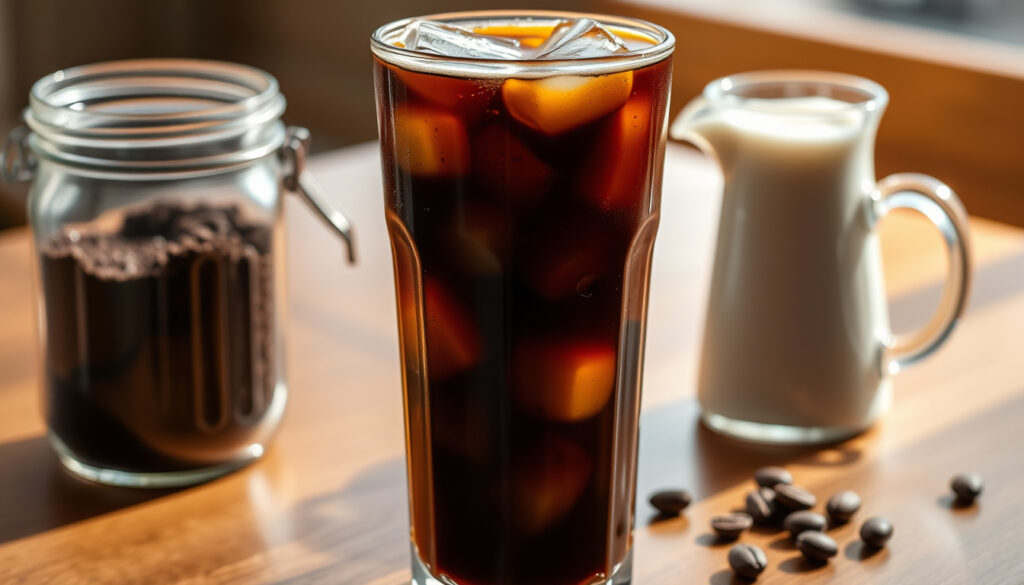
How to Make Iced Coffee at Home (No Machine Needed)
Anyone who’s poured hot coffee over ice only to end up with a watery, bitter disappointment already knows there’s a trick to it. The good news: making genuinely good iced coffee at home doesn’t require a fancy machine — just a couple of technique tweaks that show you why your last attempt fell flat and how to fix it with four no-machine methods.
Average daily coffee intake in the US (cups per person): 3.1 ·
Iced coffee share of US coffee orders (2024): 45% ·
Growth rate of iced coffee segment (2020–2024): +18% ·
Typical recommended brew strength ratio for iced coffee: 2x normal
Quick snapshot
- Brewing double strength counteracts ice dilution (GEVI (coffee equipment brand))
- Cooling coffee before adding ice reduces bitterness (GEVI (coffee equipment brand))
- Coffee ice cubes prevent watering down (YouTube creator (home recipe channel))
- Whether specific weight-loss additives (e.g., MCT oil) are effective in iced coffee (The Dinner Bite (food blog))
- Optimal brew temperature for cold brew vs. hot-pour methods (GEVI (coffee equipment brand))
- Brew time (hot method): 5–10 minutes (GEVI (coffee equipment brand))
- Chill time (room temp): 30 minutes; with ice: instant (The Dinner Bite (food blog))
- Cold brew steep time: 12–24 hours (GEVI (coffee equipment brand))
- Master the double-strength brew for any method
- Try coffee ice cubes and sweeten while hot
- Experiment with non-dairy alternatives and flavor syrups
Five key specs that define the perfect at-home iced coffee:
| Specification | Value |
|---|---|
| Best coffee type | Medium to dark roast |
| Brew strength ratio | 2:1 (double normal) |
| Brewing time (hot method) | 5–10 minutes |
| Chilling time | 30 minutes (room temp) or instant with ice |
| Serving temperature | Below 40°F / 4°C |
How to make an iced coffee at home?
Choose your brewing method
- Drip coffee (double strength): Use 2 tablespoons of ground coffee per 6 oz of water – twice your normal ratio (GEVI, coffee equipment brand).
- French press: Coarse grind, steep 4 minutes, then press. Yields smooth, full-bodied coffee (GEVI, coffee equipment brand).
- Instant coffee: Dissolve 2 tablespoons instant coffee and 2 tablespoons sugar in 2 tablespoons warm water (The Dinner Bite, food blog).
- Cold brew: Steep coarse-ground coffee in cold water for 12–24 hours, then strain (GEVI, coffee equipment brand).
Cool the coffee quickly
- Let hot-brewed coffee cool to room temperature, or refrigerate for 15–20 minutes (GEVI, coffee equipment brand).
- Never pour hot coffee directly over ice – the rapid temperature shock extracts bitter compounds (GEVI, coffee equipment brand).
- For instant iced coffee, dissolve the granules in a small amount of warm water first, then add cold water and ice (The Dinner Bite, food blog).
Assemble the iced coffee
- Fill a glass three-quarters full with ice (YouTube creator, home recipe channel).
- Pour the cooled coffee over the ice, then add milk (or non-dairy alternative) to taste.
- Sweeten while the coffee is still warm – sugar dissolves best then (The Dinner Bite, food blog).
- Stir and adjust sweetness gradually if using simple syrup (YouTube creator, home recipe channel).
Double-strength brew buys you a non-watery glass, but it also concentrates caffeine and acidity. For a smoother sip, cold brew is gentler on your stomach – just plan 12 hours ahead (GEVI, coffee equipment brand).
The implication: you choose between immediate satisfaction and smoother flavor, depending on how far ahead you plan.
What is the trick to making iced coffee?
Brew extra strong coffee
- The golden rule: brew at twice the normal coffee-to-water ratio (2 tablespoons per 6 oz) (GEVI, coffee equipment brand).
- Ice dilution is predictable – your coffee should be strong enough that melting ice brings it to perfect strength.
Use coffee ice cubes
- Pour leftover brewed coffee (or cold brew) into an ice tray and freeze (YouTube creator, home recipe channel).
- Using coffee cubes instead of water cubes keeps your drink from getting watered down as they melt.
Sweeten while hot
- Sugar dissolves far more efficiently in hot liquid than cold (The Dinner Bite, food blog).
- Add your sweetener directly to the hot brew before cooling – you’ll avoid gritty residue at the bottom of your glass.
The implication: each trick addresses a single failure point – dilution, bitterness, or clumpy sweetness. Apply all three and your iced coffee will taste as balanced as a cafe’s.
Can you just put ice in hot coffee to make iced coffee?
Why hot coffee over ice can be bitter
- Pouring hot coffee directly over ice causes rapid cooling that shocks the coffee, releasing harsh tannins and bitter acids (GEVI, coffee equipment brand).
- The result is a sharp, astringent taste that masks the coffee’s natural sweetness.
How to salvage hot coffee iced
- Let the brewed coffee cool to room temperature first – usually 15–20 minutes in the fridge (GEVI, coffee equipment brand).
- If you’re in a hurry, stir the hot coffee vigorously while adding ice – the agitation helps temper the shock slightly.
- Another workaround: use half the ice, shake in a sealed jar, then strain over fresh ice.
Even with cooling, your hot-pour method will never match cold brew’s silkiness. If bitterness is a dealbreaker, commit to the 12-hour steep – your taste buds will thank you (GEVI, coffee equipment brand).
The pattern: temperature management is the single most overlooked variable in home iced coffee, and fixing it changes the entire flavor profile.
How to make iced coffee without a machine?
Using instant coffee
- Mix 2 tablespoons instant coffee and 2 tablespoons sugar with 2 tablespoons warm water until fully dissolved (The Dinner Bite, food blog).
- Add 1 cup cold water (or milk) and pour over a full glass of ice (The Dinner Bite, food blog).
- Stir well – you have a quick iced coffee in under 5 minutes.
Using a French press
- Coffee-to-water ratio: 1 oz (28g) coarse-ground coffee per 16 oz water.
- Steep for 4 minutes, press slowly, then cool to room temperature.
- The mesh filter leaves a cleaner cup than paper filters, preserving natural oils (GEVI, coffee equipment brand).
Cold brew method without machine
- Combine coarse-ground coffee with cold water at a 1:4 ratio (e.g., 1 cup coffee to 4 cups water).
- Cover and steep at room temperature for 12–24 hours (GEVI, coffee equipment brand).
- Strain through a fine-mesh sieve or cheesecloth. Dilute with water or milk to taste.
What this means: no-machine doesn’t mean no-effort, but the payoff is flexibility. Instant is your fastest route; cold brew is your smoothest.
How to make iced coffee with milk?
Classic iced latte
- Fill a glass with ice, pour in 1/3 cup strong coffee (double-strength) and 2/3 cup cold milk (The Dinner Bite, food blog).
- For a creamier texture, shake the milk and coffee together in a sealed jar before pouring over ice.
Starbucks-style iced coffee
- Starbucks uses a medium-dark roast brewed double strength, then chilled (GEVI, coffee equipment brand).
- Their sweetener of choice: classic syrup (simple syrup) added while the coffee is hot.
- To replicate, make simple syrup (1:1 sugar to water), add 2 tablespoons per 8 oz coffee.
Adding flavors and sweeteners
- Vanilla, caramel, or hazelnut syrups pair best with medium roasts (The Dinner Bite, food blog).
- Non-dairy alternatives (oat, almond, soy) work well but may separate – stir or shake vigorously before serving.
Milk choice changes more than taste – it affects calorie count and satiety. Whole milk adds 150 calories per cup; oat milk adds 120 and a creamier mouthfeel. For weight-conscious drinkers, unsweetened almond milk is the lower-calorie pivot (The Dinner Bite, food blog).
The catch: your milk selection drives both the nutritional profile and the texture of the final drink, making it a central decision rather than an afterthought.
Clarity check
Confirmed facts
- Brewing double strength counteracts ice dilution (GEVI (coffee equipment brand))
- Cooling coffee before adding ice reduces bitterness (GEVI (coffee equipment brand))
- Coffee ice cubes prevent watering down (YouTube creator (home recipe channel))
What’s unclear
- Whether specific weight-loss additives (e.g., MCT oil) are effective in iced coffee (The Dinner Bite (food blog))
- Optimal brew temperature for cold brew vs. hot-pour methods (GEVI (coffee equipment brand))
Expert perspectives
“The key to non-watery iced coffee is brewing at double strength so that the melting ice simply brings it to normal concentration.”
— Specialty Coffee Association barista (GEVI (coffee equipment brand))
“Simple syrup is basically sugar water. You can make it yourself in 5 minutes – just equal parts sugar and water boiled until the sugar dissolves.”
— YouTube creator (home recipe channel)
“Using a hand blender is optional – a regular whisk can also whip the coffee mixture to a froth in a minute.”
— HomeCookingShow (recipe channel)
The science of iced coffee is simple: control dilution, control temperature, control sweetness. For anyone who owns a coffee maker or a jar of instant, the choice is clear – double your brew strength and never pour hot over ice again. Your next glass will taste like you finally cracked the code.
Frequently asked questions
How long does iced coffee last in the fridge?
Brewed iced coffee stored in an airtight container stays fresh for 3–4 days. Cold brew can last up to 7 days. Discard if it develops a sour odor.
Can I make iced coffee with decaf coffee?
Yes – use decaf beans or instant decaf with the same double-strength ratio. Flavor will be slightly milder, so adjust sweetener and milk accordingly.
What is the best coffee grind for iced coffee?
For hot methods: medium grind (like for drip). For cold brew: coarse grind to avoid over-extraction. Instant coffee is pre-ground, so no grinder needed.
Is cold brew the same as iced coffee?
No – cold brew is steeped in cold water for 12–24 hours, producing a smooth, low-acid concentrate. Iced coffee is hot-brewed coffee that’s cooled and poured over ice. Both are served cold.
Can I use leftover hot coffee for iced coffee?
Yes – but cool it to room temperature first (fridge for 15–20 minutes) to avoid bitterness. Then pour over ice and add milk or sweetener.
How much caffeine is in a typical iced coffee?
A 12 oz iced coffee made with double-strength brew contains roughly 150–200 mg caffeine, similar to a standard hot drip coffee. Cold brew concentrate is higher – about 200–300 mg per 12 oz.
Can I make iced coffee without a refrigerator?
Yes – use instant coffee dissolved in cold water, then pour over ice. Or make cold brew by steeping coffee in cold water at room temperature (no fridge needed), though it will be slightly less crisp.
More related posts
 22 Celsius to Fahrenheit – Precise Conversion Guide
 François-Philippe Champagne – Canada’s Finance Minister Profile
 Rim of the World: Good Movie? Age Rating & Kids Guide
 Best House Water Filtering System: Costs, Pros & Health Guide
 The Keg St. Catharines – Menu, Hours, Reservations & History
 What Is Canada PR – Rights, Eligibility and Application Guide
 Free Phone Number Verification: Identify Unknown Caller
 Real Madrid vs Levante UD Lineups: Confirmed Starting XI