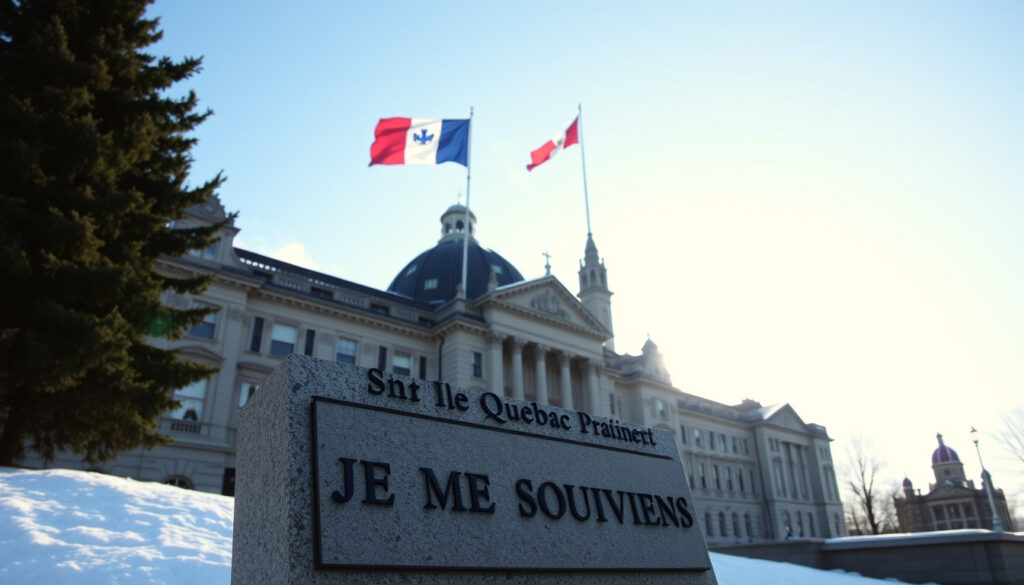
Je Me Souviens Meaning: Quebec Motto History & Facts
There’s a phrase that greets you the moment you cross into Quebec, printed on every license plate and carved into the stone of its parliament building. It’s short, French, and deceptively simple: “Je me souviens.” You’ve probably seen it and wondered what it actually means, or why a whole province chose those three words as its motto.
Official motto of Quebec since: 1939 ·
Appears on Quebec license plates since: 1978 ·
Literal translation: I remember ·
Language: French ·
Designer of coat of arms: Eugène-Étienne Taché
Quick snapshot
- Official motto of Quebec since 1939 (Government of Quebec (provincial authority))
- Literal translation: “I remember” (Translation Bureau / TERMIUM Plus (federal language authority))
- Appears on Quebec license plates since 1978 (The Canadian Encyclopedia (national reference work))
- Designed by Eugène-Étienne Taché (The Canadian Encyclopedia (biographical entry))
- What exactly Taché intended the motto to refer to (The Canadian Encyclopedia (history section))
- Whether the full proposed inscription was ever official (The Canadian Encyclopedia (history section))
- 1868: Coat of arms of Quebec adopted with motto (National Assembly of Quebec (legislative authority))
- 1978: Motto appears on Quebec license plates (SAAQ (Quebec auto insurance regulator))
- The motto continues as a central symbol of Quebec identity (Encyclopaedia Britannica (international reference))
- Debates about its meaning persist among historians and Quebecois (Encyclopaedia Britannica (international reference))
Here are the key facts about Quebec’s motto, from adoption to modern usage.
| Label | Value |
|---|---|
| Official motto of | Quebec |
| Adopted | 1939 |
| Designer | Eugène-Étienne Taché |
| License plate debut | 1978 |
| Language | French |
Why does Quebec say “je me souviens”?
Quebec adopted “Je me souviens” as its official motto in 1939, but the phrase itself is older. The words were first carved into the stone of the Quebec Parliament Building by architect Eugène-Étienne Taché in the 1880s (National Assembly of Quebec (legislative archive)). Taché designed the provincial coat of arms and placed the motto at its base. The imagery was deliberate: the motto was meant to evoke the province’s French heritage and its survival after the British conquest.
What is the history behind the motto?
Taché designed the coat of arms of Quebec in 1868, incorporating “Je me souviens” at the bottom (The Canadian Encyclopedia (architectural biography)). The shield combines symbols of both French and British rule: three fleurs-de-lis for the French monarchy, and a lion for the British Crown. The motto sits underneath as a unifying statement. Official government interpretation ties the phrase to remembrance of the province’s entire history and heritage (Government of Quebec (provincial portal)).
When was it adopted?
The provincial government made “Je me souviens” the official motto of Quebec in 1939, more than 70 years after Taché first placed it on the coat of arms (Government of Quebec (provincial symbols page)). The delay reflects the evolution of the phrase from a decorative inscription into a formal state symbol. By 1939, the motto had already become a fixture of Quebec’s civic identity.
Why is it on license plates?
Before 1978, Quebec license plates carried the slogan “La belle province” (“The beautiful province”). The government redesigned the plates that year and replaced it with “Je me souviens” (The Canadian Encyclopedia (license plate history)). The Quebec auto insurance board SAAQ now issues all plates with the motto printed across the bottom (SAAQ (licensing authority)). It’s one of the most visible daily reminders of the phrase — every car in the province carries it.
What are some interpretations of “Je me souviens”?
For a three-word phrase, “Je me souviens” carries an unusual amount of ambiguity. The Government of Quebec’s official explanation ties it to remembrance of the province’s history and heritage (Government of Quebec (provincial portal)), but leaves the exact scope open. Historians and Quebecois have filled that gap with competing readings.
What does it mean to Quebecois?
For many French-speaking Quebecois, the motto functions as a statement of cultural memory. It references the province’s French colonial origins under the Ancien Régime, the British conquest of 1760, and the long effort to preserve French language and institutions in an English-dominated Canada (The Canadian Encyclopedia (motto analysis)). The phrase is frequently cited in contexts of Francophone identity. Encyclopaedia Britannica notes that the motto is “often discussed as a cultural symbol of Francophone identity in a predominantly English-speaking Canada” (Encyclopaedia Britannica (Quebec entry)).
What this means: For Quebecois, the motto functions as a cultural anchor, connecting present-day identity to centuries of French heritage and political survival in an English-majority country.
Is there a full phrase?
Some historians have pointed to a longer inscription that Taché reportedly planned to place under the coat of arms. According to this version, the full line would have been: “Je me souviens que sous le ciel de la Nouvelle-France, et sous le ciel de la France, nous avons su garder notre foi, notre langue, et notre liberté” (I remember that under the sky of New France, and under the sky of France, we knew how to keep our faith, our language, and our liberty). There is no official record confirming this as an adopted phrase (The Canadian Encyclopedia (history section)). The ambiguity itself has become part of the motto’s function.
What is the poem connection?
“Je me souviens” is also the title of a well-known poem by Octave Crémazie, a 19th-century Quebec poet often called the father of French-Canadian poetry. His poem, published in the 1850s, is a meditation on nostalgia and loss. The connection between the motto and the poem is often noted, but no direct evidence ties Taché’s choice of words to Crémazie’s poem. The common theme of memory creates a natural resonance.
The motto’s power comes from its very imprecision. If Taché had carved a specific historical reference, the phrase would be an artifact. By leaving it open, he turned three words into a vessel that every generation of Quebecois can fill with its own meaning.
How do you pronounce “je me souviens”?
The pronunciation follows standard French rules. The phrase breaks into three words: je (zhuh), me (muh), souviens (soo-vee-en). The final s in “souviens” is silent. Example pronunciations are available on audio databases such as Forvo (Forvo (pronunciation database)).
Phonetic breakdown
The precise phonetic transcription in the International Phonetic Alphabet is /ʒə mə su.vjɛn/. This breaks down as: the “j” in je sounds like the “s” in “pleasure”; me is a short “muh” sound; souviens starts with “soo”, then “vee”, then a nasal “en”.
Common mistakes
English speakers may be tempted to pronounce the final “s” in “souviens” as a hard “s” sound, similar to the English “souvenir.” In standard French, the “ns” ending is not articulated. Additionally, the liaison between “me” and “souviens” is optional but common in careful speech. Over-enunciating each word separately makes the phrase sound unnatural.
The pattern: For a French phrase seen by millions daily, the pronunciation is straightforward. The real complexity isn’t in how you say it, but in what it means.
How to use “je me souviens”?
Outside of its official use as a motto, “je me souviens” is a perfectly normal French sentence. It means “I remember,” and it follows the standard grammatical rules of the reflexive verb se souvenir.
Grammatical structure
“Je me souviens” uses the first-person singular conjugation of the reflexive verb se souvenir. The “me” is the reflexive pronoun. In French, if you want to say “I remember something,” you add the preposition de after the verb. The full construction is je me souviens de [noun]. For example: “Je me souviens de mon enfance” means “I remember my childhood.”
Example sentences
Here are a few common ways to use the phrase:
- Je me souviens de ce film — I remember that movie
- Je ne me souviens pas — I don’t remember
- Tu te souviens de moi? — Do you remember me?
- Je me souviendrai toujours de ce jour — I will always remember that day
Learners who use “je me souviens” as a set phrase in Quebec will be understood perfectly. But the reflex to add de after it for an object is non-negotiable — dropping it creates a grammatical error that native speakers will notice.
What is the full phrase of “Je me souviens”?
There is no official full version of the motto. The three words “Je me souviens” stand alone as Quebec’s official motto, and the government’s symbolic descriptions treat them as a complete sentence.
Is it incomplete?
The phrase is grammatically complete: “I remember” is a full sentence in both French and English. The question of incompleteness arises only from the historical claim about Taché’s intended longer inscription. That longer version has never been adopted as an official symbol.
Possible completions
Several completions have been proposed by historians and in popular discussion. The most commonly cited is Taché’s reported inscription about New France. Others include more modern interpretations, like “Je me souviens du Québec” (I remember Quebec). These remain unofficial additions.
Why this matters: The absence of an official full text is not a historical accident. A fixed completion would freeze the meaning, and the motto’s endurance owes a great deal to its flexibility.
Timeline
- 1868: Coat of arms of Quebec adopted with motto “Je me souviens” (National Assembly of Quebec (legislative archive))
- 1939: “Je me souviens” officially adopted as provincial motto (Government of Quebec (provincial portal))
- 1978: Motto appears on Quebec license plates (SAAQ (licensing authority))
Clarity check
Confirmed facts
- Motto adopted in 1939 (Government of Quebec)
- Literal translation “I remember” (Translation Bureau)
- Appears on license plates since 1978 (Canadian Encyclopedia)
- Designed by Eugène-Étienne Taché (Canadian Encyclopedia)
What’s unclear
- What exactly Taché intended the phrase to refer to (Canadian Encyclopedia)
- Whether the full proposed inscription was ever official
Related reading
- Ma Meilleure Ennemie Lyrics: English Translation, Meaning & More
- Le Journal de Montréal Today: Delivery, Readership & Key Facts
youtube.com, howtopronounce.com, youtube.com, travelcuriousoften.com
The history of Quebec’s motto is closely tied to its appearance on license plates, and Quebecs license plate motto provides further insight into its meaning.
Frequently asked questions
What is the English translation of “je me souviens”?
The direct translation is “I remember.”
Is “Je me souviens” used in France?
The phrase is standard French and can be used anywhere in the French-speaking world. However, as an official motto, it is unique to Quebec.
Who designed the Quebec coat of arms?
Eugène-Étienne Taché designed the coat of arms in 1868 and included the motto “Je me souviens.”
How do you spell “je me souviens”?
It is spelled: j-e space m-e space s-o-u-v-i-e-n-s.
Can “je me souviens” be used as a regular phrase in conversation?
Yes. It is a standard French sentence meaning “I remember” and follows normal grammar rules.
What is the difference between “se souvenir” and “rappeler”?
“Se souvenir” means “to remember” and uses the preposition de. “Rappeler” means “to recall” or “to remind,” does not always take de, and is less common in Quebec.
For anyone encountering Quebec’s motto for the first time — whether on a license plate, a government building, or a conversation about Canadian identity — the meaning is both simple and bottomless. The phrase is three words. The history behind it spans centuries. The choice for learners and travellers is clear: learn to say it correctly, understand what it means, and respect what it represents, or risk missing the signal that a whole province uses to tell you who they are.
More related posts
 Price of Bitcoin USD: Live Chart & 2030 Forecasts
 Best Car Phone Mounts 2026: Expert-Tested for Heat & Safety
 How Many Grams in a Pound? Exact Conversion + Chart
 Did the Liberals Win a Majority? Carney’s 2026 Win
 Toronto Condos for Sale – Prices Fall to $627K in 2026
 Will Seniors Get Extra Money This Month in Canada? 2025 Updates
 Niagara Falls Review Obituaries: Past 7 Days & Archives
 98.5 Montreal Live Stream | Listen 98.5 FM Online Free