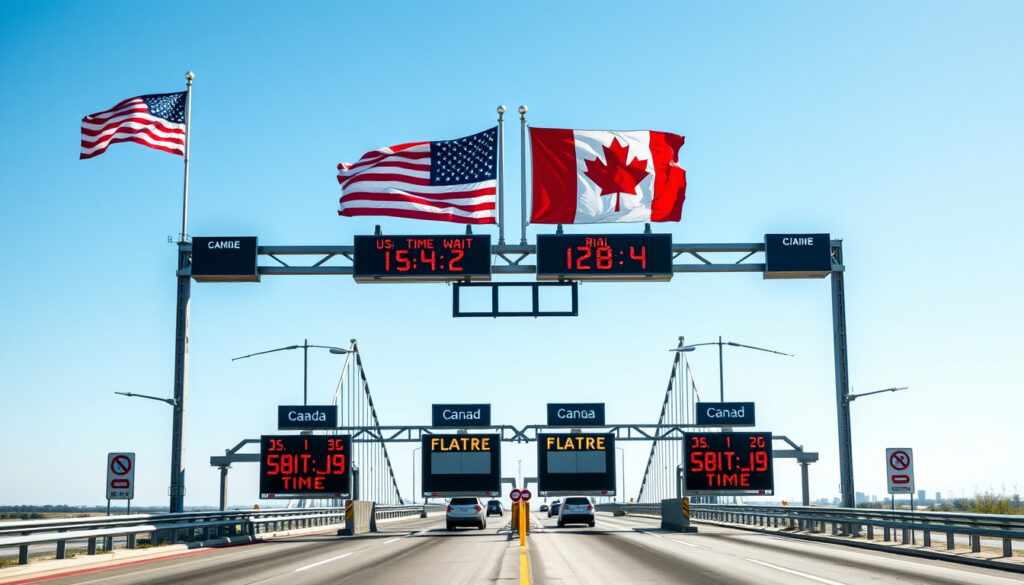
Border Crossing Wait Times: Real-Time US-Canada Tools
Real-time border wait data turns a roll-of-the-dice crossing into a calculated decision. Both Canada and the United States publish 24/7, lane-level estimates at 29 monitored ports of entry, and free mobile apps let you comparison-shop your crossing before you commit to a line. The key numbers to know: SENTRI and NEXUS lanes target 15 minutes; Ready Lanes aim for half the general-lane wait; and the Peace Bridge and Queenston Lewiston Bridge see the highest volumes in the Ontario–New York corridor.
SENTRI/NEXUS Lanes Goal: 15 minutes · Ready Lanes Goal: 50% of general lane wait · CBP Ports Covered: 24/7 estimates · CBSA Busiest Crossings: 29 land borders · BorderAlarm Feature: User-shared real-time waits
Quick snapshot
- U.S. Customs and Border Protection maintains an official wait-times portal at CBP Border Wait Times with 24/7 lane-level estimates
- Ireland and Dublin land-border real-time wait data is not available through official U.S./Canada channels covered by this guide
- Saint-Bernard-de-Lacolle crossing in Quebec remains under redevelopment, with delays expected through Winter 2027 (CBSA)
- Both the CBP BWT and CBSA CanBorder apps are available for Android and iOS, with the latter offering a trip-planner feature for optimizing crossing timing
The table below consolidates all primary resources referenced throughout this guide.
| Resource | URL / Platform |
|---|---|
| US CBP Site | bwt.cbp.gov |
| Canada CBSA Site | cbsa-asfc.gc.ca/bwt-taf |
| BorderAlarm (User Reports) | borderalarm.com |
| CBP Mobile App | Apple App Store · Google Play |
| CBSA CanBorder App | Apple App Store (Canada) · Google Play |
| CBP Historical Data | bwt.cbp.gov/historical |
| NITTEC (Niagara Region) | nittec.org |
Canada to U.S. Border Wait Times
Whether you’re crossing from British Columbia, Ontario, or Quebec, the U.S. Customs and Border Protection agency runs the definitive dashboard for wait estimates at American ports of entry. The CBP Border Wait Times portal covers all major Canada–U.S. land crossings and breaks down wait data by lane type: Standard, SENTRI, NEXUS, FAST, and Ready Lane.
BC Crossings
British Columbia’s Pacific crossings — including the Pacific Highway, Douglas/Blaine, and Huntingdon/Abbotsford — typically show short delays. The Canada Border Services Agency reported travelers at Pacific Highway facing 5-minute waits in both northbound and southbound directions during off-peak periods.
Ontario Crossings
The Ontario–New York corridor is one of the most monitored in North America. The Niagara International Transportation Technology Coalition (NITTEC) provides real-time traffic updates for the Niagara region. At the Ontario end, the CBSA’s CanBorder app showed sample waits of just 2 minutes at Queenston Lewiston Bridge and 1 minute at Niagara Falls Rainbow Bridge during a recent check.
Niagara Specifics
The Peace Bridge between Fort Erie, Ontario, and Buffalo, New York, is among the region’s busiest crossings. Sample CBSA data showed 2-minute waits for travelers and 4-minute waits for commercial traffic at the Fort Erie entry point. The CBP BWT app includes map links and webcam access for the Peace Bridge, Lewiston, and Niagara crossings via the Apple App Store version, helping drivers verify conditions before departing.
The Peace Bridge and Queenston Lewiston Bridge handle high volumes during summer weekends and holiday periods. NITTEC’s real-time data is particularly valuable during these peaks.
Pacific Border Crossing Wait Times
For travelers in the Pacific Northwest, real-time border wait information comes from both official government sources and regional webcam networks.
Live Cameras
Several cities along the Canada–Washington border operate traffic webcams that offer a visual check on crossing conditions. Route 99 cameras managed by local news outlets provide a quick visual on the Douglas/Blaine crossing line length. These are not official wait-time sources, but they complement the CBP and CBSA numerical estimates.
BC Specific Tools
The CBSA’s border wait times portal lists BC crossings including Abbotsford-Huntingdon and Pacific Highway. The CBP BWT app covers the U.S. side of these crossings and color-codes waits into three categories: 0–30 minutes (green), 31–60 minutes (yellow), and over 60 minutes (red). Users can view all ports simultaneously or filter by specific port group.
Webcams show line length but cannot tell you how fast the lane is moving. Official wait estimates include processing speed assumptions, making them more useful for trip planning than visual checks alone.
Canada Border Wait Times
The Canadian side of the border is managed by the Canada Border Services Agency, which monitors 29 of the busiest land crossings from the United States. The CBSA border wait times page publishes real-time estimates for both commercial and traveler flows.
From US to Canada
Most of the 29 CBSA-monitored crossings report No Delay conditions for both commercial and traveler traffic. The CBSA notes that wait times can increase due to events, holidays, or enforcement actions such as drug or firearm seizures. The agency explicitly advises travelers to check road and bridge conditions — like the Ambassador Bridge and Peace Bridge — before reaching the port, as traffic congestion before the border is not reflected in border wait estimates.
General Land Crossings
The CBSA CanBorder app, developed by the Canada Border Services Agency, offers a trip planner function that suggests the best day, time, and crossing port based on historical patterns. The app uses geolocation and allows users to save favorite ports for faster access during repeat trips. It is available for both Android and iOS platforms.
“Infrastructure permitting, the processing goals CBP has set for travelers are: SENTRI/NEXUS Lanes: 15 minutes, Ready Lanes: 50% of general traffic lane wait times.”
— U.S. Customs and Border Protection (official portal)
The implication is that enrolled travelers can plan around a concrete 15-minute ceiling, while Ready Lane users should compare their estimated wait against the general lane figure to gauge the advantage.
Border Crossing Wait Times Near Dublin
Unlike the well-instrumented Canada–U.S. land border, the Ireland–Northern Ireland crossing does not have a comparable real-time wait data system published through the sources covered in this article. This guide focuses on the official tools available from CBP and CBSA for North American crossings.
Ireland Border Checks
Cross-border travel between the Republic of Ireland and Northern Ireland is governed by the Common Travel Area agreement. While there are no systematic physical border checks, processing times at ports and airports can vary based on documentation checks. Specific real-time land-border wait data for Ireland was not found in the sources reviewed for this article.
Border Crossing Wait Times Near Ireland
The Dublin area includes several ports of entry, including Dublin Airport and ferry ports. Wait times at these points tend to be shorter during off-peak weekday hours.
Dublin Area Crossings
While the focus of this article is the Canada–U.S. border, the comparison between different border wait systems highlights a gap: major European land crossings similarly lack coordinated real-time wait publishing. For Dublin-area travel, checking with the Irish Naturalisation and Immigration Service or Transport Infrastructure Ireland is recommended for current conditions.
How to Check Border Wait Times: Step by Step
Whether you prefer a mobile app or a web browser, here is how to get the most current wait estimates before you drive.
- Pick your side: Decide whether you want U.S.-side estimates (CBP) or Canada-side estimates (CBSA). Both apps show bi-directional data for the major crossings.
- Open the CBP BWT app or visit bwt.cbp.gov: Select your port of entry, then filter by lane type — Standard, SENTRI, NEXUS, or Ready Lane. The color-coded display (green/yellow/red) gives an instant read of current conditions.
- Cross-check with CBSA CanBorder: Open the CanBorder app to see the Canadian-side estimate for the same crossing. This is especially useful at Niagara, Peace Bridge, and Pacific Highway crossings.
- Use the trip planner: The CanBorder app’s trip planner function lets you input your planned crossing port and suggests optimal days and times based on historical data. Plan your mid-week, early-morning crossings when possible.
- Check NITTEC for the Niagara region: Visit nittec.org for real-time traffic and border conditions specific to the Western New York and Southern Ontario corridor.
- Refresh and recheck before departure: Both agencies advise refreshing the wait time page for the latest estimates, as conditions can change rapidly during enforcement actions or high-volume events.
Comparison: CBP BWT App vs. CBSA CanBorder
The table below maps feature-by-feature differences between the two official apps to help cross-border travelers choose the right tool for their needs.
| Feature | CBP BWT App | CBSA CanBorder |
|---|---|---|
| Platforms | Android, iOS | Android, iOS |
| Provider | U.S. Customs and Border Protection | Canada Border Services Agency |
| Lane type breakdown | Standard, SENTRI, NEXUS, FAST, Ready Lane | Commercial, Travelers (general) |
| Trip planner | No | Yes — best day, time, port suggestions |
| Map + webcams | Yes — includes Peace Bridge, Lewiston, Niagara links | Geolocation + favorite ports |
| Historical data access | Yes — via bwt.cbp.gov/historical | Not directly in app |
| Real-time updates | 24/7 estimates, color-coded categories | 29 busiest crossings, refresh recommended |
Install both apps. CBP BWT wins on lane-level detail; CanBorder wins on trip planning and geolocation. Together, they cover every angle a cross-border traveler needs.
Confirmed Facts and Uncertainties
Confirmed
- CBP sets a fixed 15-minute processing goal for SENTRI and NEXUS lanes (CBP)
- CBP sets a 50% goal for Ready Lanes compared to general traffic waits (CBP)
- CBSA monitors 29 of the busiest land crossings from the U.S. into Canada (CBSA)
- Both CBP BWT and CBSA CanBorder are free services provided by government agencies (Google Play, Google Play)
- Saint-Bernard-de-Lacolle crossing is under redevelopment with delays expected through Winter 2027 (CBSA)
What’s unclear
- Official Ireland land-border real-time wait data is not available through CBP or CBSA channels
- Update frequency for CBSA wait estimates is not explicitly stated on the agency’s site
- Whether BorderAlarm’s user-reported data is aggregated or validated against official figures has not been confirmed
“The CanBorder app provides estimated wait times at select ports of entry in Canada and the United States. Short on time? Use the trip planner function.”
— Canada Border Services Agency (Google Play listing)
Related reading: Canada PR eligibility and rights
Travelers use CBP BWT and CBSA CanBorder apps effectively, just as live CBP and CBSA updates help track delays at BC, Ontario, and Niagara crossings.
Frequently Asked Questions
How accurate are CBP border wait times?
CBP wait estimates are based on specific estimation methods and are updated continuously. They represent the agency’s current assessment of processing times, but actual waits can vary due to individual document checks, enforcement actions, or sudden traffic surges.
What is BorderAlarm and how to use it?
BorderAlarm is a user-reporting platform where travelers share their observed wait times at border crossings. It supplements official data with crowd-sourced information and can be accessed at borderalarm.com. Reports are submitted by users in real time.
Which borders does CBSA track?
CBSA monitors 29 of the busiest land crossings from the U.S. into Canada, including the Pacific Highway, Douglas/Blaine, Peace Bridge, Queenston Lewiston Bridge, and Saint-Bernard-de-Lacolle. Most of these report No Delay under normal conditions.
Are there apps for border crossing wait times?
Yes. The CBP BWT app (available on Apple App Store and Google Play) and the CBSA CanBorder app (available on Apple App Store and Google Play) both provide free, government-verified wait estimates.
How to report your own border wait time?
You can share your observed wait through BorderAlarm by visiting borderalarm.com and submitting a report with your crossing location and wait duration. This helps other travelers calibrate their expectations.
What affects border crossing wait times?
CBSA notes that wait times vary due to events, holidays, and enforcement actions such as drug or firearm seizures. Road congestion leading to the border (e.g., bridge delays before the port) is not included in border wait estimates.
Are NEXUS lanes always faster?
NEXUS lanes target a 15-minute maximum processing time, making them consistently faster than general lanes. However, during enforcement operations or exceptionally high traffic volumes, even NEXUS waits can exceed the target. The Ready Lane alternative aims for 50% of general lane wait times.
For cross-border travelers, the availability of free, government-backed wait-time data is a genuine upgrade from relying on guesswork. Downloading both the CBP BWT and CBSA CanBorder apps before a trip — and checking NITTEC if you’re driving the Niagara corridor — gives you a real-time picture that 15-minute SENTRI targets and crowd-sourced reports cannot replace. The one caveat: those numbers are snapshots, not promises. Build in a buffer, avoid peak-hours if your schedule allows, and you’ll cross smarter.
More related posts
 Pizza Quattro Formaggi Near Me – Local Spots, Recipe and Guide
 François-Philippe Champagne – Canada’s Finance Minister Profile
 What Is the Difference Between Cricket and Basketball – Complete Guide
 Grow a Garden Trade – Low-Cost Startup Guide
 Molly Gordon Movies and TV Shows – Full Filmography Guide
 Cape Breton Post Obituaries: Recent & How to Search
 Agnico Eagle Mines Stock: Price, News & Buy Analysis
 14 Celsius to Fahrenheit – 57.2°F Exact Conversion Guide