Canada Post Strike Demands 2025: Workers vs Employer
Roughly 55,000 Canada Post workers walked off the job in late 2024, creating one of the largest postal disruptions in recent Canadian history. The Canadian Union of Postal Workers demanded wage increases and benefit enhancements, while Canada Post countered with lower offers amid mounting financial losses and government pressure for structural reforms.
Proposed Wage Increase: 24% over 4 years (initial CUPW demand) · Key Benefit Enhancement: Fertility treatments coverage · Strike Suspension Status: Agreed, pending final agreements · Government Reform Demands: End home delivery, close post offices · Union Involved: Canadian Union of Postal Workers (CUPW)
Quick snapshot
- Canada Post offered 11.5% over four years (Canada Post Official)
- Strike suspended December 17, 2024 (Wikipedia)
- $3 billion in losses since 2018 (Canada Post Official)
- Final contract vote outcome
- Exact strike end date
- Full service restoration timeline
- Whether CUPW’s initial 24% demand was formally tabled
- Ratification votes pending
- Potential back-to-work legislation
- Government-pushed reforms may reshape service model
The table below summarizes key facts from the Canada Post labour dispute, sourced from official statements and verified reports.
| Label | Value |
|---|---|
| Dispute Period | 2024–2025 |
| Union | CUPW |
| Key Proposal | 24% wage hike (initial CUPW demand) |
| Government Action | Authorized reforms |
| Delivery Impact | Home delivery at risk |
| Workers on Strike | Approximately 55,000 (WSWS) |
| Canada Post H1 Loss (2024) | $490 million |
What are the Canada Post workers’ demands?
The Canadian Union of Postal Workers entered negotiations pushing for substantial wage increases and enhanced benefits. According to CUPW’s official proposals, the union proposed annual increases of 9%, 4%, 3%, and 3% over a four-year contract, which translates to approximately 19% total (CUPW Official). However, earlier reports indicated that CUPW initially demanded 24% over four years before scaling back to 19% by December 9, 2024 (Economic Times).
Wage increases sought
Beyond the headline percentage, CUPW’s proposal included a cost-of-living adjustment (COLA) clause that would trigger if inflation exceeds 10.33% quarterly—a threshold that, according to Economic Times reporting, far exceeds typical Canadian inflation triggers of around 7% (Economic Times). Canada Post countered that the union’s latest offers would cost over $3 billion over four years, describing them as “unaffordable and unsustainable” (Canada Post Official).
The gap between CUPW’s 19% demand and Canada Post’s 11.5% offer represents roughly 7.5 percentage points—equivalent to millions in compounded labour costs over the contract term.
Benefit enhancements
CUPW sought expanded health benefits, including fertility treatments coverage and increased short-term disability payments to 80% of wages. The union also proposed 10 medical days plus 7 personal days (CUPW Official). Additionally, CUPW demanded that contracted staff be made permanent employees and sought protections preventing contracting out of bargaining unit work for Rural and Suburban Mail Carriers (RSMC).
Job security issues
Job security formed a central part of the union’s platform. CUPW demanded protections against service cuts and opposed Canada Post’s proposal to implement seven-day parcel delivery using part-time staff. The union insisted weekend delivery be handled by full-time employees (Canada Post Official).
Canada Post proposed protecting the defined benefit pension for current employees—a key retention tool—but coupled this with staffing flexibility that the union rejected.
Why is Canada Post striking again?
The 2024–2025 dispute represents the culmination of years of deteriorating finances at Canada Post. The Crown corporation recorded losses exceeding $3 billion since 2018, with its 2024 loss marking the seventh consecutive annual loss (Canada Post Official). In the first six months of 2024 alone, Canada Post lost $490 million (Canada Post Official).
Negotiation history
Formal negotiations began on November 15, 2023 (Canada Post Official). Canada Post presented offers of 10% over four years on September 25, 2024, followed by an improved offer of 11.5% on October 29, 2024. A previous 13% offer had been rejected by workers (Economic Times).
Government intervention
The Trudeau government appointed mediators and backed management’s position for reform, including potentially ending home delivery in some areas and consolidating post offices. The government’s stance positioned Canada Post as needing structural changes to remain viable, putting the union in conflict not just with the employer but with federal policy direction.
Previous strike patterns
CUPW announced its strike mandate on October 25, 2024 (Canada Post Official). The required cooling-off period ended November 2, 2024 (Canada Post Official), clearing the path for work stoppages.
The pattern: Both parties exchanged proposals through December—Canada Post presented a framework on December 1, 2024, and CUPW offered counter-proposals on December 5, 2024—yet neither side moved enough to reach agreement before the strike suspended (Canada Post Official).
How much are Canada Post workers getting paid?
While exact salary ranges for Canada Post employees vary by position and location, the core dispute centred on future increases rather than current base pay. According to reports, the average Canada Post worker earns a middle-range wage compared to other federal public sector employees, with benefits that the union views as insufficient to keep pace with inflation and private-sector alternatives.
Current salary ranges
Canada Post’s official statements did not disclose specific current salary figures but focused on the cost of proposed increases. The employer characterized CUPW’s demands as adding “billions of dollars in long-term fixed costs” (Canada Post Official).
Proposed adjustments
The comparison is stark: CUPW sought approximately 19% over four years, while Canada Post offered 11.5% (compounded to 11.97%). The union initially demanded 24% before reducing to 19% by December 9, 2024 (Wikipedia).
Comparison to inflation
With Canadian inflation having spiked in recent years, the union argued that real wages would decline without significant increases. Canada Post countered that its offer, combined with pension protections, represented a fair package given the corporation’s financial position.
Do staff get paid if they go on strike?
No. Workers participating in a legal strike do not receive pay from Canada Post during the work stoppage. This is standard under Canadian labour law for federally regulated industries, including Canada Post.
Strike pay rules
The Canada Labour Code governs these negotiations, setting rules around strike notice periods and cooling-off requirements. Workers who strike legally are protected from termination but lose their regular employer-provided wages for the duration.
Union support funds
CUPW maintains a strike fund to provide financial support to members during work stoppages, though the exact amounts and duration of such payments depend on the union’s financial reserves and the length of the dispute.
Legal context in Canada
Federally regulated employees like those at Canada Post must complete a cooling-off period before striking legally. Once that period ends and if no agreement is reached, a legal strike can proceed. The union followed these procedures, announcing its strike mandate on October 25, 2024, and waiting until the cooling-off period ended November 2, 2024.
The catch: Without pay from either the employer or robust union strike funds, prolonged work stoppages create real hardship for postal workers—giving both sides incentive to reach a settlement quickly.
Can I still receive mail during a Canada Post strike?
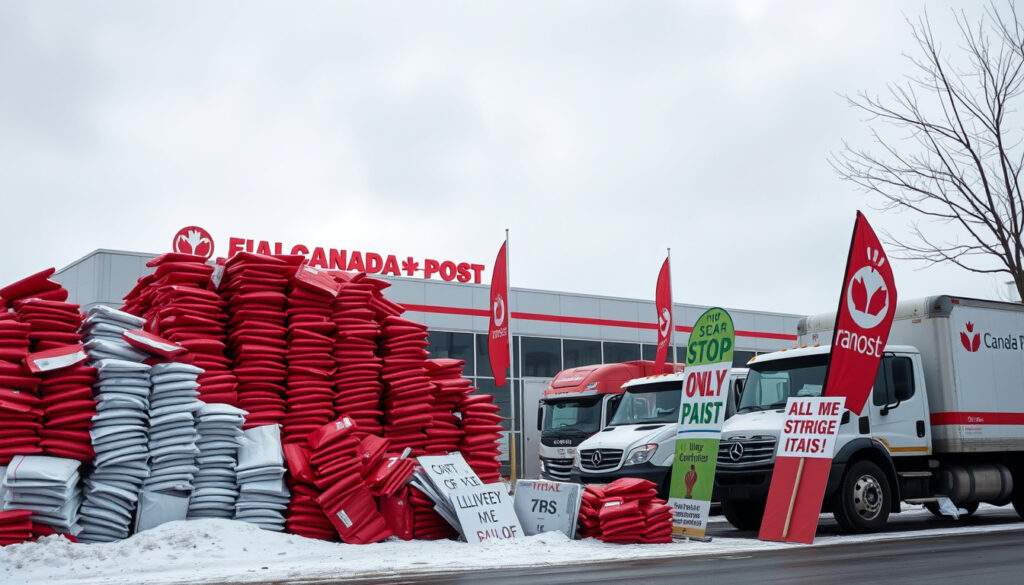
During the active strike period from November 15 to December 17, 2024, delivery services were severely disrupted. Mail and parcels accumulated at facilities, and consumers faced delays for anything already in the system.
Delivery disruptions
Approximately 55,000 Canada Post workers were on strike (WSWS), effectively halting processing and delivery across the country during the work stoppage.
Alternatives available
Consumers turned to private carriers like UPS, FedEx, and Purolator for urgent shipments—options that typically cost more but maintained reliability during the disruption.
Parcel handling changes
With the strike now suspended and pending final agreements, Canada Post has indicated plans for service restoration, though the timeline remains uncertain. Some reports suggest potential changes to the service model, including reforms that could affect home delivery availability in certain areas.
The government’s push for reform may reshape Canada’s postal service fundamentally—potentially ending door-to-door delivery in favour of community mailboxes, which would affect how Canadians receive correspondence regardless of strike outcomes.
Timeline of the Canada Post Labour Dispute
Key dates mark the progression of negotiations, strike activity, and suspension of the labour dispute.
| Date | Event |
|---|---|
| November 15, 2023 | Formal negotiations began |
| September 25, 2024 | Canada Post presented initial 10% offer |
| October 25, 2024 | CUPW announced strike mandate |
| November 2, 2024 | Cooling-off period ended |
| November 15, 2024 | First strike began |
| December 1, 2024 | Canada Post presented framework |
| December 9, 2024 | CUPW reduced demands to 19% |
| December 17, 2024 | Strike activity suspended |
Confirmed Facts vs. What’s Still Unclear
Confirmed
- Canada Post’s 11.5% wage offer over four years (October 29, 2024)
- Strike suspension agreement (December 17, 2024)
- Government reform authorization
- $3 billion in losses since 2018
- CUPW proposed 9%, 4%, 3%, 3% annual increases
- Cooling-off period ended November 2, 2024
Unclear
- Whether CUPW formally tabled 24% or if this was an opening position
- Exact number of workers affected by each bargaining unit
- Final contract vote outcome
- Whether tentative agreements have been reached
- Full service restoration timeline
- Specifics of government reform demands
What the Parties Are Saying
The union’s demands are unaffordable and unsustainable – adding billions of dollars in long-term fixed costs.
— Canada Post (Official Statement)
True progress requires meaningful engagement, not surface-level proposals, or new demands that derail progress.
— CUPW Negotiators (via CUPW Official)
The rhetoric from both sides reflects the fundamental tension: Canada Post points to mounting losses and argues it cannot sustain what it calls unrealistic labour costs, while CUPW argues that workers should not bear the burden of corporate restructuring decisions they had no part in making.
Summary
The Canada Post labour dispute reveals a corporation struggling with structural financial challenges colliding with workers who fear losing hard-won benefits and job security. With Canada Post having lost over $3 billion since 2018 and its 2024 loss marking the seventh consecutive annual deficit, the employer argued it had no choice but to push for cost containment. For Canadian consumers, the stakes are equally concrete: mail delays, parcel uncertainty, and potentially sweeping changes to how postal service operates across the country. Whether the suspended strike resumes or a final agreement emerges, both sides face pressure to demonstrate that meaningful progress was made—something that remains far from certain.
Related reading: Canada’s Finance Minister
canadapost-postescanada.ca, canadapost-postescanada.ca, canadapost-postescanada.ca, infopost.ca, infopost.ca, cupw.ca
CUPW pushes for wage hikes and enhanced benefits against Canada Post’s 11.5% offer amid reforms, with the CUPW strike demands breakdownproviding status and schedule details.
Frequently asked questions
What caused the 2024–2025 Canada Post strike?
The strike resulted from failed negotiations over wages, benefits, and job security. CUPW sought significant wage increases (initially 24%, later reduced to 19%) while demanding protections against service cuts, while Canada Post countered with 11.5% and pushed for staffing flexibility. Years of financial losses—over $3 billion since 2018—fueled the employer’s push for structural reforms.
What is the current status of Canada Post negotiations?
Strike activity was suspended on December 17, 2024, with both parties continuing negotiations toward final agreements. Ratification votes on tentative deals remain pending, and the outcome of those votes will determine whether service normalizes or work stoppages resume.
How has the government intervened in the Canada Post dispute?
The Trudeau government appointed mediators and backed management’s position for reforms, including potentially ending home delivery in some areas and consolidating post offices. The government’s stance signaled that Canada Post needed structural changes to remain viable, complicating negotiations.
What changes to parcel rates during strike?
Some reports indicated that a $2 flat rate parcel increase was announced during the dispute, though specific details and timing of any rate changes remained unclear as of the strike suspension.
What is Canada Post strike history?
Canada Post has experienced previous labour disruptions, with the 2024–2025 dispute representing one of the most significant. The current conflict follows patterns of previous negotiations where wage demands, benefit improvements, and job security protections have been central issues.
Will Canada Post strike affect holidays?
The timing of the strike—spanning mid-November through mid-December—coincided with the holiday shipping season, causing significant disruption to gift deliveries and last-minute shipments. The suspension before the holiday peak offered some relief, but backlogs likely persisted.
What alternatives to Canada Post during strike?
Consumers relied on private carriers such as UPS, FedEx, and Purolator for urgent deliveries during the work stoppage. While more expensive than Canada Post, these alternatives maintained service reliability throughout the disruption.
More related posts
 Megan Fox Machine Gun Kelly: Split Confirmed, No Reunion
 Andrew Chang: Career, Personal Life, and Key Answers
 Billy Beane: Career, Moneyball Accuracy, Net Worth & More
 What Is the Difference Between Cricket and Basketball – Complete Guide
 Square One Insurance Services Reviews: Real Customer Feedback
 Mrunal Thakur: Age, Movies, Rumors, Egg Freezing Facts
 2025 Income Tax Calculator – Brackets, Rates and Estimator Guide
 Montreal Canadiens Free Live Stream on CBC Gem